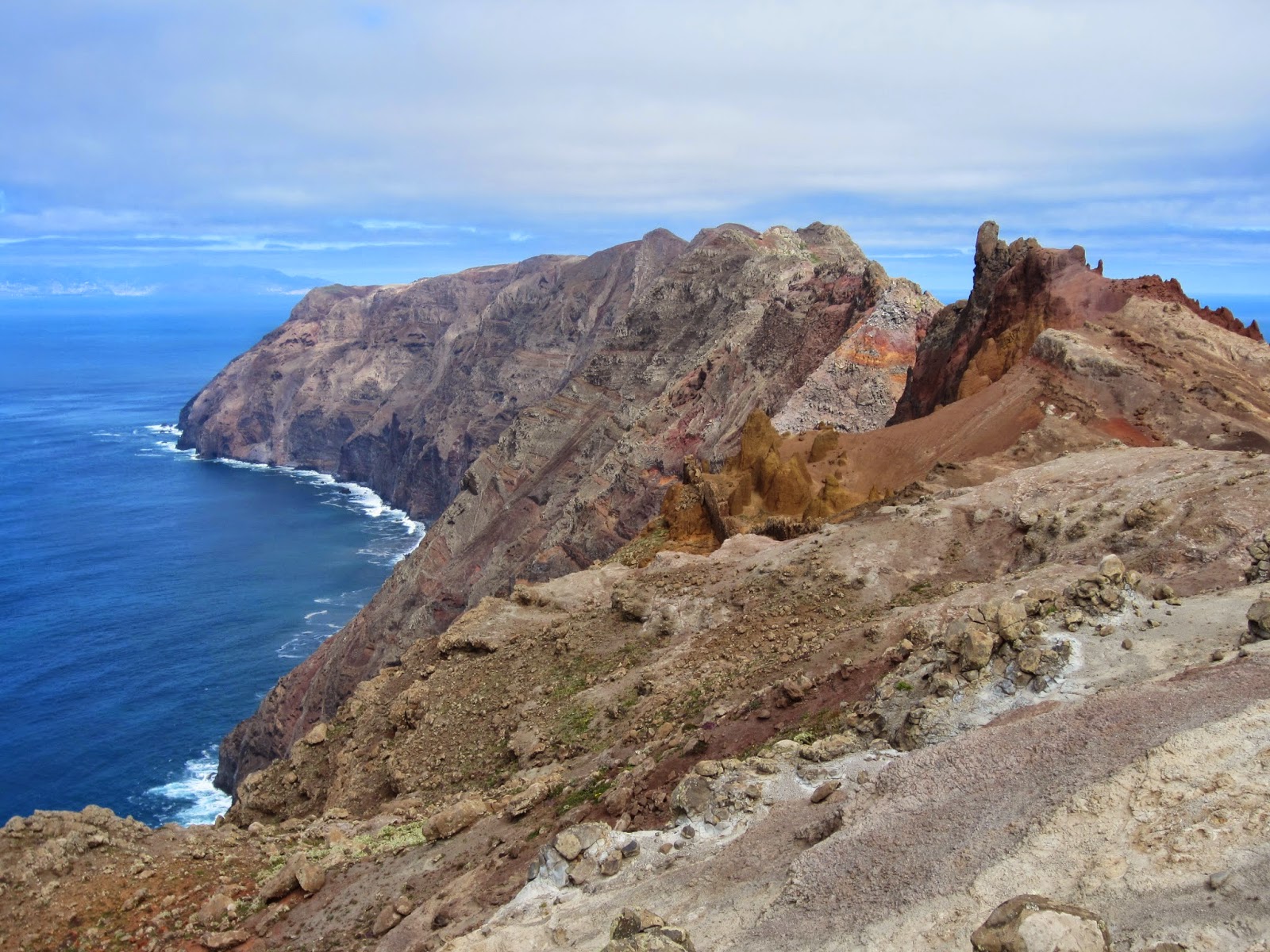
Tenho ficado com a Sandra e a Sole no Ilhéu do Farol (Ponta de São
Lourenço, Madeira) durante 5 dias para começar a campanha do pintainho (Puffinus
lherminieri) dentro do projeto LIFE
Recover-Natura que coordina
o Serviço do Parque Natural da Mareira (SPNM). O nosso trabalho, nesta
fase do estudo, é pesquisar ninhos desta ave, ainda não confirmada a sua
presença ou aninhamento neste ilhéu; mas dadas as características do local é
possível que goste deste lugar.
Last
month I travelled with Sandra and Sole to a little island called “Ilhéu do
Farol” (Ponta de São Lourenço, Madeira) to stay 5 days on the project LIFE Recover-Natura
of Serviço do Parque Natural da Mareira (SPNM). Our work consists in to look
for nests of a little seabird, the Audubon's
Shearwater ou pintainho (Puffinus lherminieri)
to confir their presence at this place which looks like its usual habitat.
 |
| O pequeno embarcadouro |
Chegamos num bote zodiac de manhã, com os vigilantes do SPNM. No desembarco há uma pequena
plataforma numa baía ainda mais pequena, varrida pelas ondas. Até lá chegam
umas escadas que serpenteiam pela ladeira, descendo desde o farol, no ponto
mais alto do ilhéu. Após saltarmos a terra entre as ondas contínuas, conseguimos levar
a terra todo a equipagem (mochilas, uma cozinha portátil, tenda de campismo,
comida, água…) todos a correr pelo solo escorregadio para salvar o material do
mar. E ao fim respiramos.
We arrive on a zodiac boat in the morning. To go ashore there is a
little platform in a too little bay, with high waves. Here starts a stair which
rises until the lighthouse, at the top of island. After unload the bags (a
portable kitchen, the tent, the backpacks, food, water…) and move it to a safe
space, through the slippery ground, we could breath.
As escadas ascendem pelo lado menos escarpado do ilhéu, conectando
o pequeno “embarcadouro” com o farol. Mas a metade do ascenso há uma pequena
casa ruinosa que foi o nosso melhor resguardo: dentro dela cabe a tenda e as
nossas coisas, protegidas do vento omnipresente e da chuva prevista.
The stairs ascend at least cliff side of the islet, connecting the small
"dock" with the lighthouse. But half the rise there is a small house
ruinous that will be our best guard: we planned to plant inside the tent and
our things, protected from the omnipresent wind and rain expected.
 |
| A pequena casa fica no lado mais resguardado do ilhéu |
Quando tudo ficou pronto, olhei em volta e lembrei-me duma frase dum
personagem de fantasía chamado El Jormaz de Saralham, quando visitou as Tombas
do Vento: “Conheço esse vento. Faz-te sangrar primeiro, ensurdecer depois, e
enlouquecer finalmente. Conheço esse vento.” Se calhar nos não vamos sangrar
pelos ouvidos, mas é um vento constante de noroeste, com rajadas que fizeram-me
perder o equilíbrio e cair ao chão; é aconselhável manter-se longe das bordas
das encostas. Durante os dois primeiros dias tivemos ventos muito fortes, com
nuvens cinzentas e chuvisco. Mas no terceiro dia tem amanhecido com o sol a
brilhar sobre o mar e o vento mais calmo.
When everything was ready, I looked around and I remembered a sentence
of a fantasy character called El Jormaz of Saralham, when he visited the tombs
of the Wind, "I know this wind. Make
yourself bleed first, deaf later, and finally go mad. I know this wind”
Maybe we will not bleed through the ears, but it is a steady wind from the
northwest, with gusts that made me lose my balance and fall to the ground.; it
is advisable to keep away from the edges of cliffs. During the first few days
we have had very strong winds, with gray clouds and drizzle. But on the third
day has dawned with the sun shining on the sea and the wind calmer.
No primeiro dia, depois do almoço, fomos fazer um pouco de
exploração. Sabíamos que havia um ponto complicado no acantilado que só pode
ser cruzado em baixa-mar por um lugar escorregado, e trepar uma parede
vulcânica com ajuda de cordas. Além disso, não podemos esquecer de voltar
rápido para não ficar atrapadas naquele lugar por causa da maré cheia.
On
the first day, after eating, we have gone to explore a little bit. We know that
there is a delicate point in the cliffs that can only be crossed at low tide by
a slippery place, and climb a volcanic wall with a rope. And we can’t forget to
come back soon after to be catched in that place because of the high tide.

Terminei com os dedos cheios de feridas de trepar pelas ásperas
rochas basálticas. As zonas perigosas pareciam ainda mais estéreis e selvagens.
Ficamos ali sentadas uns minutos, a ver as grandes ondas a passar pelo canal
entre o nosso ilhéu e o do Desembarcadouro, ao oeste. As ondas levantavam mais
de dois metros e o vento despenteava-las, como uma cabeleira branca de espuma
trás de se, iluminadas pela luz cor laranja do crepúsculo. Uma imagem de beleza
sobrenatural.
Pelas noites fazíamos escutas, para tentar confirmar a presença do
pintainho. Sentávamo-nos ao resguardo de uma das cavernas calcárias no topo do
acantilado, ou na porta do farol, protegidas do vento, com as luzes apagadas,
em silêncio, para escutar os cantos das aves marinhas que aproveitam a
escuridadão da lua nova para aproximarem-se a terra sem ser vistos pelas
gaivotas, grandes predadoras das aves marinhas.
I finished with my fingers full of
wounds caused for climb the rough basalt rocks. The dangerous area seemed even
more barren and wild than the others. We were sitting there for a few minutes,
watching the big waves passing through the channel between our islet and the
Desembarcadouro islet, into the west. The waves were risen over two meters and
the wind disarranged their top with a white mane of foam behind him. An image
of unearthly beauty.
In the evenings we did listens to try to confirm the presence of the
pintainho. We sat in the guard of one of the limestone caves at the top of the
cliff, or in the lighthouse door, protected from the wind, with the lights off,
in silence, listening to the songs of seabirds that take advantage of the
darkness of the new moon for approaching the land without being seen by gulls,
the great predators of the seabirds.

Mas as noites foram silenciosas. Além de alguns grasnidos das
gaivotas, escutamos aos roques de castro (Hidrobates
castro), que se aproximavam a nos na escuridadão, em voo rasante para
olhar quem é que nos éramos. São muito curiosos. Uma noite estávamos já prontas
para dormir, e um deles entrou na casa, entre as mochilas. Sacamos-lhe para
fora e como vimos que tinha uma anilha metálica, apontamos o número antes de
solta-lho.
But the nights were quiet. In addition to some squawks of seagulls, we
listen to roques de castro ou Band-rumped Storm-petrel (Hidrobates castro), approaching to us in the
darkness, to investigate our identity. They are very curious. One night we were
already prepared to sleep, and one of them entered the house, between the
backpacks. We saw it had a metal ring, and we noted down the number before
releasing him.
 |
| Um roquinho curioso |
Á tarde e à noite descíamos ás encostas a procura dos ninhos. Encontramos primeiro um ovo pequeno no topo duma fenda. Trepei para ver si ainda estava quente, mas como estava frio guardei-o para examiná-lo. Era muito pequeno para ter sido dum pintainho; pensamos que poderia ser de Alma Negra (Bulweria bulwerii), abandonado desde o ano passado. Pouco depois Sandra voltou com outro ovo abandonado, era diferente, maior, branco e com outra forma. Sole disse que tinha forma de ovo de pintainho, e essa noite deitamo-nos muito contentes, com esta prova da presença no ilhéu.
In the afternoon and evening we walked down to the cliffs search of nests. We first a small egg on top of a slit. I climbed up to see him was still warm, but I was cold-picked him to examine him. It was too small to have been of a chick; thought it might be of Alma Negra ou Bulwer's Petrel (Bulweria bulwerii), abandoned since last year. Shortly after Sandra came back with another abandoado egg, was different, larger, white and otherwise. Sole said he had ways of chick egg, and that night we lay down much wrangling with this evidence of their presence in the islet.
 |
| O ilheu Bartolo |
Também visitava-mos ao Bartolo, o nome que demos a uma grande
rocha com a forma de um gigante comerochas, corcunda e com a boca aberta, na
metade da encosta. Utilizávamos como ponto de orientação naquele labirinto de
pedras pretas e blocos de basalto que trepávamos como gatas a procura de ocos e
fendas que pareceram ninhos. A última tarde sentámo-nos num lugar desde onde
víamos uma gruta que rugia com as ondas furiosas do mar, que levantavam uma
bela cortina de espuma branca. De repente, Sole gritou emocionada apontando ao
mar. Estávamos a ver um lobo marinho! Ficava muito perto de nós, e eu acho que
assustou-se do barulho que fizemos com a nossa alegria, porque olhou para nós
com a sua cabeça e mergulhou nesse momento. Estávamos muito contentes de ter
visto este animal, nenhuma das três tínhamos visto nunca um deles em liberdade.
Also we visited to Bartolo, the name we gave to a large rock in the
shape of a giant comerrocas, humpback and with his mouth open in the mid-cliff.
We used it as an orientation point in that maze of black stones and basalt
blocks which we were climbing as cats looking for hollow and cracks that looked
like nests. The last afternoon we sat in a place from what we saw a cave that
roared with wild waves of the sea, which raised a beautiful white foam curtain.
Suddenly Sole shouted thrilled pointing to the sea. We were watching a sea
wolf! It was very close to us, and I think that scared up the noise we made
with our joy, because look at us with his head and dove right now. We were very
pleased seeing this animal, none of the three had never seen one in the wild.
 |
| O pequeno almoço do ultimo dia |
No último dia tínhamos encontrado ao menos 6 ovos abandonados
diferentes. Metemos num pacote bem protegido para levar à sede da SPEA para o
seu estúdio pormenorizado e recolhemos toda a nossa equipagem para descer de
novo até o pequeno embarcadouro. Mas o bote zodiac dos vigilantes do Parque
Natural não chegava! Se calhar o mar estava muito mau? Íamos ficar no ilhéu
abandonadas nós também, da mesma forma que os ovos?
Uma hora mais tarde, a Laura, a nossa colega que tinha ficado com
a Estefania no ilhéu do Desembarcadouro, ligou para nós a dizer que tinha visto
o bote zodiac na nossa direção! Estávamos salvas!
PS: Temos medido os ovos e nenhum é de pintainho… são muito
pequenos. É possível que o pequeno seja de roque de castro, e os restantes de
Alma Negra. Na próxima lua nova, vamos continuar a nossa pesquisa no pequeno
ilhéu com a esperança de encontrar alguma pista da presença desta pequena ave
marinha.
On the last day we had found
at least 6 different abandoned eggs. We put in a well-protected package to
carry to SPEA headquarters for a detailed studio; then we collect all our
lugagge to descend again until the small dock. But the zodiac boat of the
Natural Park was not coming! Maybe the sea was very bad? We were going to stay
in abandoned islet us also, like eggs?
An hour later, Laura, our
companion who had been with Estefania in the Desembarcadouro islet, I call in
to say he had seen the zodiac boat in our direction! We were saved!
PS: We have measured the eggs
and not one is from pintainho ... they are very small. It is possible that
small is from roque de castro, and the rest of Black Soul. On the next new
moon, let's move our research on the islet with the hope of finding some clue
of the presence of this small seabird.